

A picture of misery
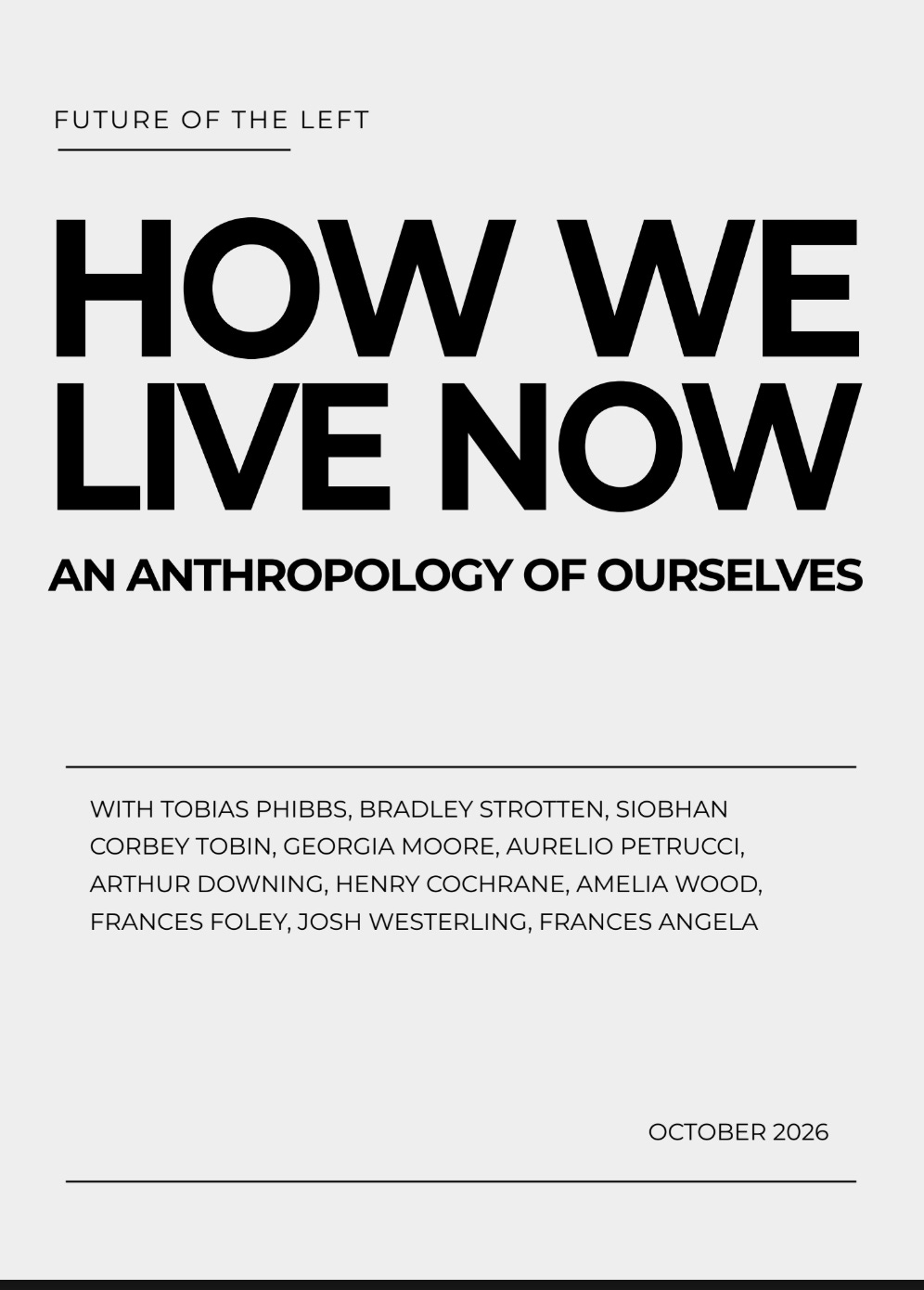
I’ve just read Future of the Left’s new collection, How We Live Now: An Anthropology of Ourselves, and I recommend you do too. Thirty-two pages, ten essays and an introduction, all doable in one sitting. If you’ve got to be upbeat at your next meeting or social do, read it afterwards. It achieves the rare feat for a collection of essays by adding up to something greater than the sum of its parts.
It paints a picture of misery.
Turn the collection’s title into a question – how do we live now? – and the answer it gives us is along the lines of ‘unhappily, alone’. Piece after piece describes a nation struggling under the weight of its own depression, unable to adapt to a world of screens, atomised where the past – or at least a recited version of it – promised strong bonds and a life worth living.
The darkness is everywhere. The man in Wigan the local teenagers call a crackhead, who has just killed a pigeon and says he’ll cook it for his dinner. The lads still living with their parents who could be better off than when they were growing up but spend their money on beer and coke. England fans in a Putney pub performing feelings they don’t have. An old man found dead in his hallway, his house burgled after the funeral, his sewing tin torn open and scattered across the floor.
Then there’s the mood music we’ve grown used to. A customer in Thanet who watches immigrants who don’t speak English push in front of him at the till, while he pays “through the nose” in tax. Young professionals with no hope of owning the kind of house they grew up in, or of doing better than their parents. And a “neighbourhood panopticon” of Ring doorbells that might catch a parcel thief but has replaced the neighbours.
Modern Britain. Heating off, huddled under a blanket of depression.
Strikingly, those who have climbed from under it carry a kind of guilt, or at least unease, that spills onto the page. Bradley Strotten, son of a care nurse and an HGV driver and now a company director based in Dubai, betrays it best. He has “earned (a strange word) mobility but lacks belonging", calling himself “a Blairite dream”. I should declare an interest. I was born in Bootle, went to a Liverpool comp, then uni in London, and I work for Tony Blair. I’m the Blairite dream too. I know the pull of the place you left. I just don’t think the answer is guilt.
Bad policy, not just bad luck
In his excellent introduction, Tobias Phibbs warns that policy made in a political vacuum “can’t see the wood for the trees, and the public feel it.” He’s right. A politics that is bloodless and lifeless, that turns up with the right answer and then departs the stage, won’t survive. It won’t even work. It isn’t really politics.
But he is careful to add that politics needs technocrats and good policy improves lives. The collection proves it from the other side, because so many of the grievances woven into that blanket are the product of bad policy – especially our broken welfare system. In a hospital waiting room in the small hours, one writer meets a woman with a learning disability who has to fill in PIP forms to prove she can’t fill in forms.
Perhaps the collection’s greatest contribution to the future of the left isn’t what it tells us about how people live, but what they live without.
Identity.
It’s strange. In a world where the left’s blind embrace of identity politics made identities readily available – gender, ethnicity – author and subjects alike seem to be yearning for something bigger. A collective identity. You can see it in Arthur Downing’s essay on the old friendly societies, with their “daft name and a real purpose”. A West Ham fan who would rather watch England at home finds it for ninety minutes against Argentina: “the feeling of being part of something larger”.
This is where I think the political response to Britain’s collective depression lies. A national project to reverse its driver – economic and public service decline – that people can find themselves in. One built around the future and a clear appraisal of the world we’re living in.
It needs something the collection barely mentions: political leadership. Perhaps for good reason. We’ve been starved of it. Picture a similar collection written in the 1980s; it would be peppered with Thatcher. Blair in the 90s. Here, Keir Starmer gets a single line in the introduction, as a politician who never seemed to come from anywhere, and Andy Burnham appears once, in an essay on Wigan, as the new prime minister whose “Makerfield test” sent Westminster back to Orwell.
Nostalgia is a poor guide
The collection seems to sense the crossroads: go back, or go forward. The introduction closes by saying the place the Labour movement began “is where it should return.”
The easier pick is the rear-view mirror. Weren’t things nicer then? Didn’t we all just get along? Perhaps. There’s a simple test: run the collection’s own exercise in earlier decades.
Write it in the 1970s and the author is one of the lucky few. Around one in twenty young people from manual working-class backgrounds went into higher education. Today more than one in four children who grew up on free school meals – a tougher test of disadvantage – are in higher education by 19. Our 1970s essay writer would describe rubbish piled high in squalid public spaces and draw on a year - say 1979 - that lost almost 30 million working days to strikes. If they were from Merseyside, they’d talk of gravediggers walking out and coffins stuck in a warehouse in Speke. Their parents would have fought in the Second World War.
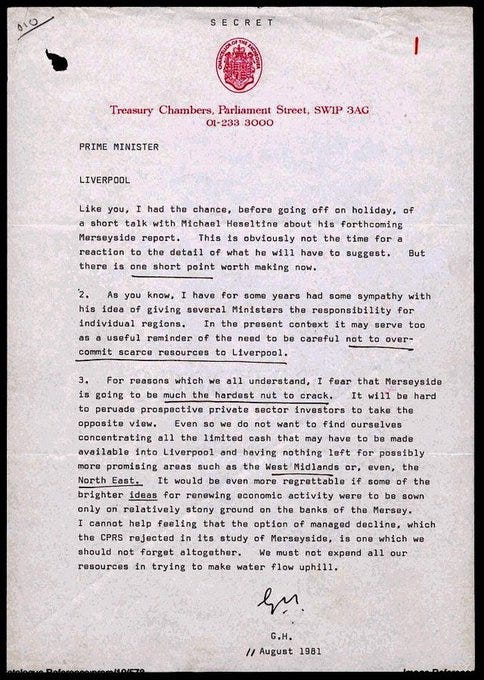
Write it in the 1980s and it’s three million on the dole, with unemployment peaking at 11.9 per cent in 1984. The gap between rich and poor, which had narrowed for forty years, widening dramatically. Industrial heartlands hollowed out while a capital city boomed for anyone without a hint of a regional accent. Our imaginary Merseyside writer would draw on the aftermath of the Toxteth riots, unaware that Thatcher’s chancellor was privately telling her that “the option of managed decline” for Liverpool should not be forgotten.
The 1990s collection? Mood is lifting. Britpop, Cool Britannia, Euro 96, when “Three Lions” was brand new and “it’s coming home” meant something. But at the turn of the decade, tens of thousands of homes were being repossessed. Unemployment was back above three million in the winter of 1992–93, and crime peaked in 1995. The Ring doorbell generation may be lonelier, but it is a great deal safer.
Today’s malaise is real, but nostalgia is a poor guide. The belonging and identity these essays occasionally mourn for were built for the conditions of its time, and one of the sharpest lines in the collection is that “we have forgotten how to invent new social forms”. Correct. That’s an argument for going forward, not back.
Forward, not back
The harder choice is to drive Britain forward.
Take on the grievances over immigration and failing integration, rather than wishing them away. The Thanet essay puts it better than most politicians: when you’re asked to be generous out of very little, “every sign of unfairness is humiliation.” The answer isn’t to tell the man in the Aldi queue complaining about immigration that he’s a bigot. It’s a system people can see is controlled and fair, where those who come learn the language and pull their weight, and where integration is something we lead on rather than leave to chance.
Don’t be beholden to technology but don’t hold back its development. Shave off its excesses and stay alive to the new ones; one writer’s “at ease” test, whether your companion can sit alone for a few minutes without reaching for their phone, is one most of us would fail. Promote a good life that is off screen and outdoors.
And treat the nation’s health as a national project. As Britain faces up to global insecurity and the real risk of war, a country’s resilience starts with the fitness of its people. Wigan, the collection notes, is Britain’s obesity capital, with seven in ten overweight or obese. Build the nation’s fitness, help the country recover from its physical and mental sickness, and make sure everyone who needs obesity-fighting drugs can get them, not just the ones who can afford them.
Don’t shy away from the technology that catches criminals and makes our lives safer. But don’t leave it to a WhatsApp group and a row of Ring doorbells. Put it at the heart of a future-facing police force. This runs against the instinctive reach for more ‘bobbies on the beat’ or ever more local police, but it addresses the very real decay brought to life in the collection.
Above all, go for growth. This isn’t a story removed from the lives of people documented in the essays. It isn’t a neoliberal pursuit. It’s about prosperity and aspiration. The father of one writer got his first pay rise in almost two decades. Almost two decades. That’s how long Britain has been stuck in its doom loop of low growth and low investment and we count the cost in slim pay packets that have lost the fight against rising prices. A country starved of prosperity stops believing in getting on, and those who do get on start to feel like deserters.
So here is the collective identity I think these essays are reaching for without naming it: aspiration. Not a private escape hatch for a lucky few, but a shared national project. An agenda for Britain that people can find themselves in. A new aspiration for a country starved of prosperity. And a plan to push that aspiration, and the prosperity that pays for it, into every postcode. If that’s the future of the left, then this essay collection is a real service to it.